https://en.wikipedia.org/wiki/Mishra_Dhatu_Nigam https://bhukhanvala.in/
Market Validation Questions
For Defense:
- Who is the actual procurement officer at DRDO/HAL for sheet metal components?
- What is their current vendor list and approval process?
- How long does vendor qualification take? (Could be 2-5 years)
- What specific programs have upcoming prototype needs?
- What materials are they working with? (AL 7075? Ti-6Al-4V? Inconel?)
- What’s their budget cycle? When do they release RFPs?
- Is there a Make in India mandate that helps you?
For Space:
- Which private space startups have raised enough money to actually buy?
- What’s Skyroot/Agnikul spending on metal forming currently?
- Does ISRO have a vendor development program you can join?
- What certifications do you need? (AS9100? NADCAP?)
For Architecture:
- Can you get 3-5 architects to sign LOIs (Letters of Intent)?
- What’s the typical project budget for facade work?
- Who makes the vendor decision — architect or contractor?
- What’s the lead time expectation? (ISF might be too slow for construction schedules)
Technical Validation Questions
- What’s the thickest material you MUST form? (1mm? 3mm? 6mm?)
- What’s the largest part dimension you MUST hit? (Is 12ft actually necessary?)
- What materials are non-negotiable? (If titanium is required, that changes everything)
- What surface finish is acceptable? (Ra 3.2µm? Ra 1.6µm? Class A?)
- What dimensional tolerance is required? (±1mm? ±0.5mm? ±0.1mm?)
- Do you need to form both sides (convex AND concave features)?
Unit Economics Questions
- What do customers currently pay for equivalent parts?
- Hand-beaten panel: ₹____/sq ft
- Imported formed part: ₹____/kg
- Machined from billet: ₹____/kg
- What’s your target price point to be competitive?
- How many hours will a typical part take to form?
- At ₹X/hour machine rate, does the math work?
- What’s the capital cost you can afford?
- ₹25 lakh? ₹50 lakh? ₹1 crore? ₹5 crore?
- What’s your break-even volume?
Competition Questions
- Who else in India is doing ANY kind of advanced forming?
- Is anyone importing AMINO or MECO machines?
- What are IITs doing with their ISF research? Any spin-offs?
- Could IIT Bombay/Madras/Hyderabad be a partner or competitor?
Go-to-Market Questions
- Should you start as a job shop (you make parts) or machine seller (you sell machines)?
- Should you offer “Forming as a Service” first to validate demand?
- Can you partner with an existing sheet metal fabricator who has customers?
- Should you locate near a defense cluster (Bangalore, Hyderabad, Pune)?
parts up to 12 ft (3.7 m) long and 5 ft (1.5 m) deep, and can shape structural sheet up to 1/4” (6.35 mm) thick with sub-millimeter precision.
- Aluminum Alloys (2xxx, 5xxx, 6xxx, 7xxx )
- Mild Steels (A1011)
- Stainless Steels* (304, 304L, 316, 316L)
- Nickel-Based Superalloys* (625, 718)
- Low Expansion Alloys* (Invar 36)
- Refractory Alloys* (Niobium C103, Haynes® 230)
- Other Specialty Alloys* (HyMu 80®, Magnesium, Brass, Bronze)
hire this people: https://www.linkedin.com/in/miguel-angel-zamora-mora-b97030107/?originalSubdomain=ch
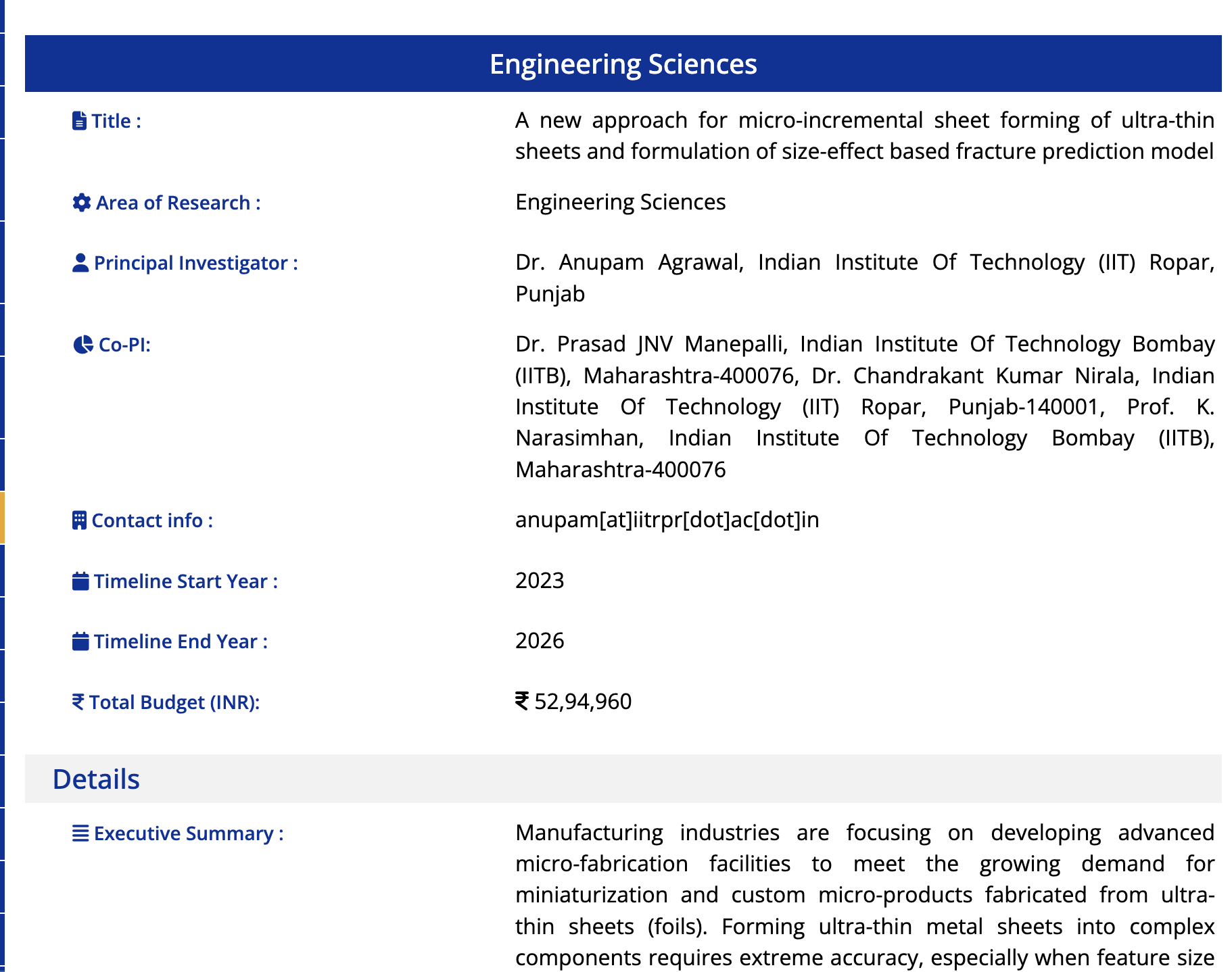
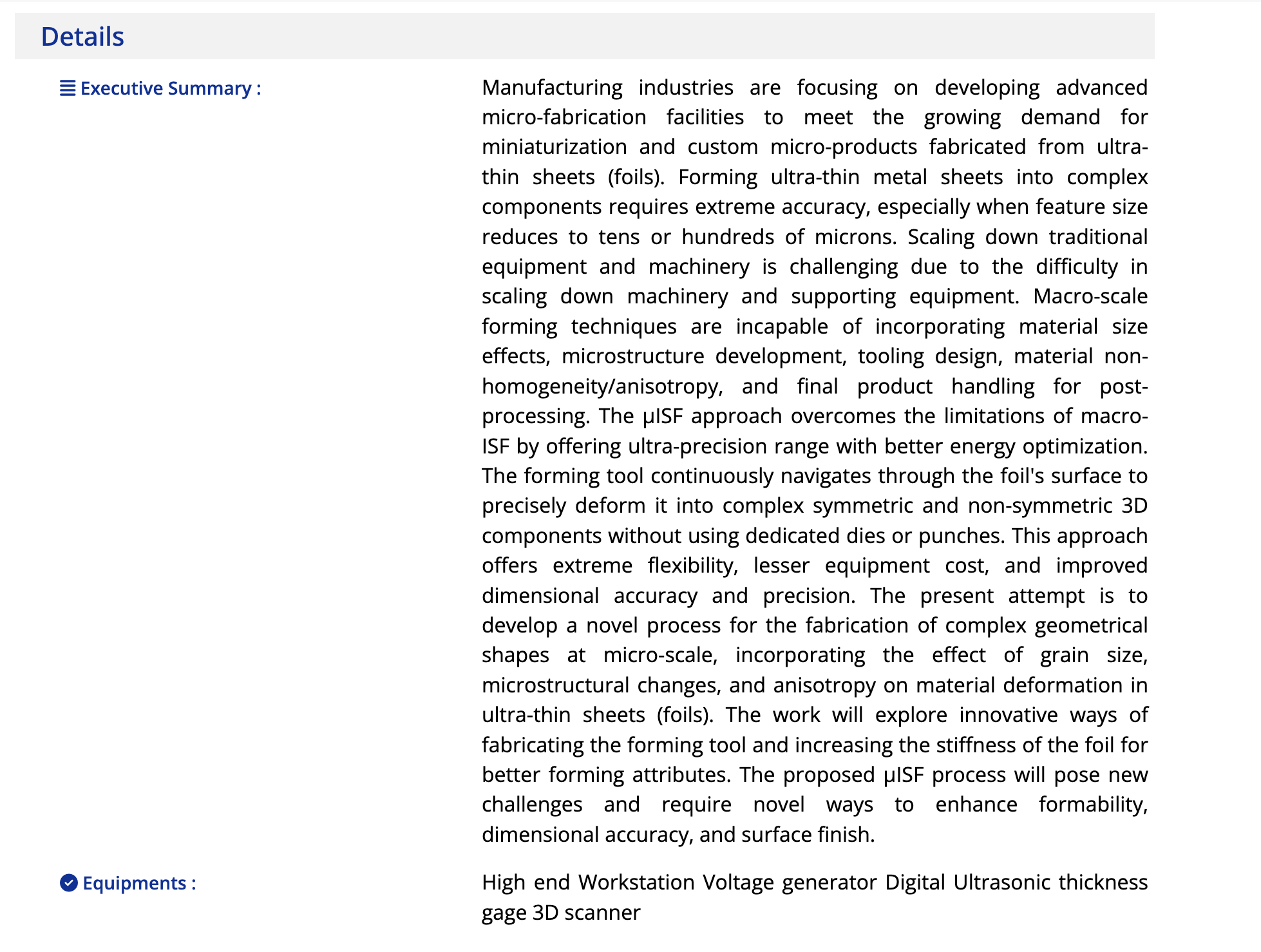
https://scholar.google.co.in/citations?user=GyTmiXIAAAAJ&hl=en
◦ IIT Kanpur: Reach out to Bharat Bhushan and Janakarajan Ramkumar. They have conducted extensive research on the simulation of ISF for titanium (Ti-6Al-4V) and aluminum alloys, particularly regarding forming forces and step-depth optimization.
◦ IIT Madras (Chennai): Contact the research team including Srivardhan Reddy Palwai and Hariharan Krishnaswamy. They recently developed a novel frequency-based approach for designing preform shapes in multi-stage roboforming to enhance forming depth.
◦ NIT Tiruchirappalli: Connect with Chinnaiyan Sathiya Narayanan. His team is leading research into using patient-specific data to generate toolpaths for custom medical implants using ISF.
◦ IIT Guwahati: Uday Shanker Dixit is a key figure in numerical modeling for ISF processes in India.
People to hire or get advice:
https://www.linkedin.com/in/narayana-murty-svs-b88b515a
Based on the sources, here are the top academic and technical experts in India you should consider for your team or as strategic consultants:
1. Specialists in Roboforming & Robot Accuracy
Since 12-foot parts are highly susceptible to robotic deflection (robots being ~98% less stiff than CNC machines), these individuals are critical for modeling stiffness and accuracy:
• Prof. Hariharan Krishnaswamy (IIT Madras): A lead researcher in robot-assisted incremental forming. He pioneered the use of Fast Fourier Transform (FFT) for preform design, which enhances forming depth by up to 235% for complex shapes like cranial implants.
• Dr. Riby Abraham Boby (IIT Jodhpur): Expert in kinematic identification and elasto-static parameter modeling. His work is vital for reducing robotic end-effector errors by identifying and compensating for link and joint compliance.
• Dr. Eldho Paul (Mar Athanasius College of Engineering): Collaborator on major roboforming studies, specifically focusing on the Lumped Stiffness Model to accurately predict path deviations under high forming loads.
2. Experts in Strategic Materials & Heat-Assisted Forming
Forming titanium and refractory alloys at 12-foot scales requires precise thermal management to ensure ductility without oxidation:
• Prof. Janakarajan Ramkumar (IIT Kanpur): A leading voice in Induction Tool Heated ISF (ITHISF). His research demonstrated a 42% reduction in peak forming forces by heating the tool itself rather than the entire sheet.
• Dr. Bharat Bhushan (IIT Kanpur): Specialized in the numerical modeling of complex shapes on Ti-6Al-4V. He has extensive experience in simulating induction heat assistance to enhance formability in high-strength alloys.
• Dr. Seikh Mustafa Kamal (Tezpur University/IIT Guwahati): Expert in thermal autofrettage and electrically-assisted manufacturing, which are critical for inducing beneficial residual stresses in strategic components.
3. AI, Soft Computing & Computational Foundations
For a “software-defined” factory, you need experts who can integrate AI into the manufacturing workflow:
• Prof. Uday Shanker Dixit (IIT Guwahati): A central figure in computational foundations for metal forming. His work integrates Finite Element Method (FEM) with soft computing to predict forming forces and thickness with less than 5% error.
• Prof. Puneet Tandon (IIITDM Jabalpur): Lead researcher on the application of Artificial Intelligence in incremental forming. He has reviewed and developed AI techniques like neural networks and genetic algorithms for predicting springback and toolpath strategies.
• Dr. Prashant Kumar Jain (IIITDM Jabalpur): Specialized in the development of expert systems and the use of deep learning to capture and reuse manufacturing knowledge as “digital tooling”.
4. Production & Strategic Application Experts
For the specific verticals of DRDO defense projects and custom medical implants:
• Prof. Chinnaiyan Sathiya Narayanan (NIT Tiruchirappalli): A specialist in patient-specific titanium implants. He developed the patented Multi-Point Incremental Forming (MPIF) tool, which uses rotating balls to improve surface finish and formability in medical-grade alloys.
• Dr. Vamsi Krishna Balla (CSIR-CGCRI Kolkata): Expert in bioceramics and metal fused filament fabrication, offering deep insight into the metallurgical integrity of titanium alloys for high-stress applications.
Strategic Hiring Strategy for Your Idea Stage
• The “Architect”: Hire someone like Sahil Bharti (IIT Madras), who has experience in the systematic analysis of geometric inaccuracies and has published extensively on both the numerical and experimental sides of roboforming.
• The “Software Lead”: Look for students or associates of Aniket Nagargoje, who focused on feature extraction and toolpath generation using clustering algorithms like DBSCAN.
Metal which we can work:
1. High-Performance Strategic Alloys (Aerospace & Defence)
These materials are critical for the Indian defence corridors and DRDO initiatives, particularly for extreme-environment hardware.
• Titanium Alloys (Ti-6Al-4V, Grades 1, 2, & 5):
◦ Applications: Used for missile skins, hypersonic vehicle structures, aircraft engine components, and satellite parts where a high strength-to-weight ratio is mandatory.
◦ Medical Benefit: Ideal for patient-specific medical implants (cranial, maxillofacial, and dental) due to its bio-inertness and osseointegration properties.
• Nickel-Based Superalloys (Inconel 625 & 718):
◦ Applications: Essential for missile bodies, turbine discs, and exhaust structures that must maintain structural integrity under intense thermal and mechanical stress.
• Refractory Alloys (Niobium C103, Haynes 230):
◦ Applications: Targeted for the skins of hypersonic test vehicles because they can withstand the extreme temperatures generated during high-mach flight.
2. Lightweight Structural Alloys (Automotive & E-Mobility)
Targeting the rapid prototyping needs of Indian EV startups and aerospace primes.
• Aluminum Alloys (2xxx, 5xxx, 6xxx, 7xxx Series):
◦ Applications: Used for EV battery enclosures, chassis components, body-in-white panels, and aircraft fuselage sections.
◦ Benefit: Roboforming handles precipitation-hardened alloys (like 7075) effectively by forming them in a ductile state and applying post-process heat treatments to achieve peak strength.
• Magnesium Alloys (AZ31):
◦ Applications: Used for extreme lightweighting in automotive parts and biodegradable biomedical implants.
3. Industrial & Precision Engineering Materials
Used for large-scale, low-volume fabrication where traditional tooling costs are prohibitive.
• Specialty and Stainless Steels (304, 304L, 316, 316L):
◦ Applications: Used for automotive exhaust systems, mufflers, high-pressure piping, and food-processing equipment.
• Low Expansion Alloys (Invar 36):
◦ Applications: Critical for precision satellite structures and high-accuracy tooling where the material must not change shape during temperature swings.
• Copper and Copper Alloys (Brass, Bronze):
◦ Applications: Used for electrical stator bars, heat exchangers, and specialised marine hardware where high conductivity and corrosion resistance are required
Revenue:
Defense & DRDO:
◦ Indigenisation Projects: The Defence Research and Development Organisation (DRDO) is a primary candidate. Your technology directly supports “Atmanirbhar Bharat” by enabling the rapid fabrication of thin-walled skins for missiles, satellite structures, and hypersonic vehicles.
◦ Defense Corridors: Target firms operating in the Tamil Nadu and Uttar Pradesh defense corridors, which are receiving significant investment for new machining cells and aerostructures.
• Aerospace (Civil and Military):
◦ Hindustan Aeronautics Limited (HAL): They have already engaged with smart manufacturing training and are a potential partner for high-performance aerostructures.
◦ New Space Startups: Companies building satellites and launch vehicles often require specialized, lightweight titanium parts (like toroidal tanks) where traditional dies are cost-prohibitive.
• Healthcare (Custom Implants):
◦ Surgeons and Specialized Hospitals: Your first commercial revenue might come from fabricating patient-specific titanium cranial or orthopedic implants. ISF can produce these in hours using scan data, a critical advantage for trauma cases.
• E-Mobility (Automotive R&D):
◦ EV Startups and Premium OEMs: Companies like Tata Motors or Mahindra (who are already adopting hot forming for BIW components) may use your services for the rapid prototyping of lightweight aluminum battery enclosures and chassis components
Investors: anchor order from HAL/Indian Navy and strategic investment from L&T or Tata would be the fastest path.
Hyperbolic Metal Forming: https://www.shoesmachines.com/hyperbolic-metal-sheet-forming-machine
This device or tool is not doing this only by pressing. It uses energy from acoustics to vibrate each surface against the opposing pin surface. It is akin to “Ultrasonic Welding” but using the vibrational energy to hammer the metal in between the pins.
Imagine this action with a hammer used by a horseshoe maker with heated metal.
The responses by readers shows how each person sees things. Some see this an mesmerizing. Some see it as clever. Some see it as a new invention. I see it as simple physics but automating a simple principle - ultrasonic vibrational shaping.
Phase 1: Start with Roboforming (0-3 years)
Why?
- Lower capital barrier to entry
- IITs already have working knowledge
- Can leverage India’s IT/AI strength
- Defense aircraft repair is immediate use case (HAL, IAF depots)
- Machina Labs model is proven — can be adapted
Action Items:
- Create a dedicated startup (or DRDO/HAL spinoff) focused on roboforming
- Partner with IIT Kanpur/BHU to commercialize existing research
- Target HAL for aircraft skin repair/prototyping (like US Air Force + Machina Labs)
- Build AI/ML capability for real-time forming compensation
Estimated Investment: ₹50-100 crore for first 3 years
Phase 2: Develop HMF/MPF for Shipbuilding (3-7 years)
Why?
- India has ₹2.3 lakh crore naval modernization pipeline
- 60+ naval vessels under construction — massive potential
- Chinese/Korean shipyards use MPF; India still uses manual line heating
- Can leapfrog to competitive position
Action Items:
- Technology transfer from Jilin University (China) or Korean institutes — or reverse engineer
- Pilot at Cochin Shipyard or GRSE — modernization budgets are available
- Develop indigenous MPF machine with Indian CNC/hydraulic manufacturers
- Target architectural/construction market as secondary (hyperbolic facades are growing)
Estimated Investment: ₹200-500 crore over 5-7 years
Phase 3A: Hybrid Manufacturing Integration (Years 7-10)
The Core Concept: Combine Additive Manufacturing (AM) + Roboforming + HMF/MPF into a single integrated cell that can produce complex parts impossible with any single technology.
Why This Matters
| Single Technology | Limitation | Hybrid Solution |
|---|---|---|
| Roboforming | Can’t add features, slow | AM adds ribs/bosses → Roboforming shapes |
| MPF | Surface defects, no fine features | AM prints functional features post-forming |
| 3D Printing alone | Slow, expensive, size-limited | Form base structure → AM adds complexity |
| Stamping | Needs expensive dies | Eliminated with hybrid flexible approach |
Technical Integration Pathway
┌─────────────────────────────────────────────────────────────────┐
│                    HYBRID FORMING CELL                         │
├─────────────────────────────────────────────────────────────────┤
│                                                                 │
│   [Sheet Metal Input]                                           │
│          ↓                                                      │
│   [Roboforming / MPF] ──→ Base 3D Shape                        │
│          ↓                                                      │
│   [DED / WAAM*] ──→ Add ribs, bosses, reinforcements           │
│          ↓                                                      │
│   [Robotic Trimming / Drilling]                                 │
│          ↓                                                      │
│   [3D Scanning + AI Quality Check]                              │
│          ↓                                                      │
│   [Finished Hybrid Part]                                        │
│                                                                 │
│   *DED = Directed Energy Deposition                             │
│   *WAAM = Wire Arc Additive Manufacturing                       │
└─────────────────────────────────────────────────────────────────┘
India’s Existing Capabilities to Leverage
| Capability | Current State | Phase 3 Integration |
|---|---|---|
| Wipro 3D | Metal AM for aerospace (HAL, ISRO) | Core AM partner |
| Godrej Aerospace | ISRO components, precision manufacturing | Integration expertise |
| IIT research | ISF, forming simulation, FEA | R&D backbone |
| L&T, Tata | Large-scale manufacturing, defense contracts | Scale-up partner |
| Objectify Technologies | AM services for DRDO, IAF | Defense qualification |
Target Applications
- Aircraft Structural Components
- Wing ribs with integrated stiffeners
- Fuselage sections with mounting bosses
- Landing gear components
- Shipbuilding
- Hull sections with integrated pipe flanges
- Bulkhead panels with reinforcement ribs
- Complex curved surfaces with attachment points
- Space
- Satellite bus structures
- Rocket tank domes
- Thrust chamber components
Phase 3B: AI-Enabled Autonomous Forming (Years 8-12)
The Vision: A forming cell that learns, adapts, and self-corrects in real-time — no human intervention needed for routine production.
Key Technology Components
| Component | Function | Current State | India’s Path |
|---|---|---|---|
| Digital Twin | Virtual replica of physical system | Siemens, Hexagon lead | Partner with TCS, Infosys for indigenous solution |
| Generative AI | Design optimization, parameter prediction | OpenAI, NVIDIA dominate | Leverage India’s AI talent pool |
| Predictive AI | Springback compensation, defect prediction | Academic research stage | Commercialize IIT algorithms |
| Agentic AI | Autonomous decision-making, self-correction | Emerging globally | First-mover opportunity |
| Computer Vision | Real-time quality inspection | Mature technology | Integrate with forming cell |
The Autonomous Forming Cell Architecture
┌──────────────────────────────────────────────────────────────────────┐
│                    AI-ENABLED AUTONOMOUS FORMING CELL                │
├──────────────────────────────────────────────────────────────────────┤
│                                                                      │
│  ┌─────────────┐     ┌─────────────┐     ┌─────────────┐            │
│  │   DIGITAL   │     │   PHYSICAL  │     │    EDGE     │            │
│  │    TWIN     │◄───►│    CELL     │◄───►│     AI      │            │
│  │  (Cloud)    │     │  (Factory)  │     │  (On-site)  │            │
│  └─────────────┘     └─────────────┘     └─────────────┘            │
│         │                   │                   │                    │
│         ▼                   ▼                   ▼                    │
│  ┌─────────────────────────────────────────────────────────┐        │
│  │              CAPABILITY STACK                            │        │
│  ├─────────────────────────────────────────────────────────┤        │
│  │ • Generative AI: Optimal tool path generation           │        │
│  │ • Predictive AI: Springback compensation in real-time   │        │
│  │ • Computer Vision: Defect detection mid-process         │        │
│  │ • Agentic AI: Autonomous parameter adjustment           │        │
│  │ • Reinforcement Learning: Continuous improvement        │        │
│  └─────────────────────────────────────────────────────────┘        │
│                                                                      │
│  INPUT: CAD file + Material spec                                     │
│  OUTPUT: Finished part (no human intervention)                       │
│                                                                      │
└──────────────────────────────────────────────────────────────────────┘
Why India Can Win Here
| Advantage | Explanation |
|---|---|
| IT/Software talent | World’s largest pool of AI/ML engineers |
| Cost arbitrage | Develop at 1/5th the cost of US/Europe |
| Captive demand | ₹2.3 lakh crore naval pipeline + HAL + ISRO |
| Leapfrog opportunity | No legacy systems to replace |
| TCS/Infosys/Wipro | Can build Digital Twin platforms |
Investment: ₹500-800 crore over 4 years Model: Joint venture between IT major (TCS/Infosys) + Manufacturing partner (L&T/Tata) + Research (IITs)
Phase 3C: The Export Play — “Forming-as-a-Service” (Years 10-15)
The Ultimate Goal: India becomes a global exporter of forming technology and forming services — not just formed parts.
Three Export Models
Model 1: Technology Export (Hardware + Software)
- Sell complete autonomous forming cells to other countries
- Target: Southeast Asia, Africa, Middle East, Latin America
- Compete with Chinese MPF machines at higher quality tier
Model 2: Forming-as-a-Service (Cloud Manufacturing)
- Customer uploads CAD → India’s factory produces → Ships globally
- Like Machina Labs but at India cost structure
- Target: Aerospace Tier-2/3 suppliers globally, shipyards
Model 3: Deployable Microfactories
- “Factory-in-a-container” — ship complete forming cell to customer site
- Operate remotely from India via Digital Twin
- Target: Defense installations, remote shipyards, disaster response
╔═══════════════════════════════════════════════════════════════════════════╗ ║ INDIA ADVANCED FORMING ROADMAP ║ ╠═══════════════════════════════════════════════════════════════════════════╣ ║ ║ ║ PHASE 1: ROBOFORMING (0-3 years) Investment: ₹50-100 Cr ║ ║ ┌─────────────────────────────────────────────────────────────────────┐ ║ ║ │ • IIT commercialization → Startup │ ║ ║ │ • HAL anchor customer (aircraft repair/prototyping) │ ║ ║ │ • Build AI/robotics capability │ ║ ║ │ • Outcome: Working roboforming cells at 2-3 defense sites │ ║ ║ └─────────────────────────────────────────────────────────────────────┘ ║ ║ │ ║ ║ ▼ ║ ║ PHASE 2: HMF/MPF (3-7 years) Investment: ₹200-500 Cr ║ ║ ┌─────────────────────────────────────────────────────────────────────┐ ║ ║ │ • Technology transfer or indigenous development │ ║ ║ │ • Pilot at Cochin Shipyard / GRSE │ ║ ║ │ • Develop springback compensation algorithms │ ║ ║ │ • Outcome: MPF machines at 2+ shipyards, architectural projects │ ║ ║ └─────────────────────────────────────────────────────────────────────┘ ║ ║ │ ║ ║ ▼ ║ ║ PHASE 3: AUTONOMOUS HYBRID FORMING (7-15 years) Investment: ₹800-1300 Cr║ ║ ┌─────────────────────────────────────────────────────────────────────┐ ║ ║ │ 3A: Hybrid AM+Forming integration │ ║ ║ │ 3B: AI-enabled autonomous cells (Digital Twin, Agentic AI) │ ║ ║ │ 3C: Export play — Technology, FaaS, Microfactories │ ║ ║ │ • Outcome: 125-225 million) over 15 years ║ ║ POTENTIAL OUTCOME: $3-4 billion annual exports by 2040 ║ ║ ║ ╚═══════════════════════════════════════════════════════════════════════════╝
Phase 4:
Start producing titanium baby!!!
FFC_Cambridge_process: https://en.wikipedia.org/wiki/FFC_Cambridge_process